The Endocannabinoid System
May 6, 2021 📙 6 min read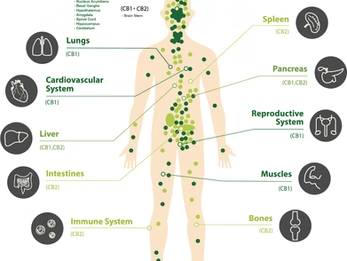
As hemp-derived products became mainstream, many people started hearing new terms—cannabinoids, endocannabinoids, terpenes, and “full-spectrum.” Behind the buzzwords is a real biological framework: an internal signaling network that helps the body adapt to change. Understanding the endocannabinoid system (ECS) gives important context for why cannabis-derived compounds can have noticeable effects—and why lifestyle factors matter, too.
The ECS is a built-in balancing system found in all mammals. It helps regulate and fine-tune everyday functions like stress response, sleep, appetite, movement, memory, mood, and immune activity. Cannabis compounds are one category of molecules that can influence this system, but they are not the only ones—your body makes its own “endocannabinoids” that act as signals when and where they’re needed.
Defining the Endocannabinoid System
Homeostasis is the body’s ability to stay stable while constantly adjusting to internal and external conditions. The ECS contributes to that stability by acting like a “modulator”—it doesn’t replace other systems, it helps tune them. Because it interacts with multiple body systems (nervous, endocrine, digestive, immune), it can influence a wide range of functions depending on where the signaling is happening.
At a high level, the ECS is commonly described as three core parts: (1) endocannabinoids (the body’s own signaling molecules), (2) receptors (cellular “docking sites” that receive signals), and (3) enzymes (the machinery that makes and breaks down these signals).
Endocannabinoids
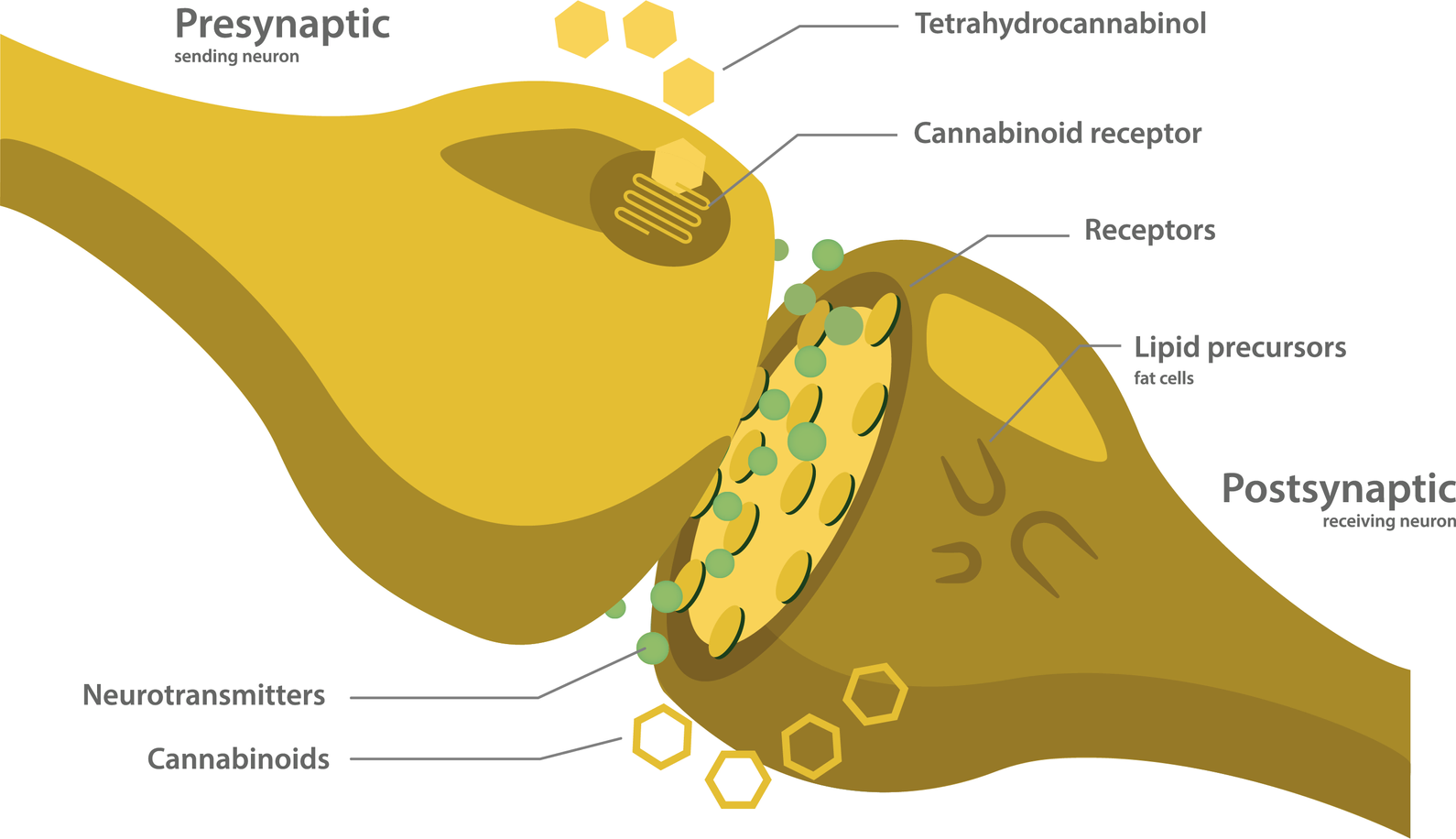
The two most-studied endocannabinoids are anandamide (AEA) and 2-arachidonoylglycerol (2-AG). Unlike many neurotransmitters that are stored and released, endocannabinoids are often produced “on demand” and act locally. A common way to describe their signaling is retrograde: they can be produced by a postsynaptic neuron and travel backward to influence activity at the presynaptic terminal—helping regulate the release of other neurotransmitters.
Endocannabinoids are sometimes described as “promiscuous” because they can interact with more than just classic cannabinoid receptors. This helps explain why ECS signaling can overlap with pain pathways, inflammatory signaling, and sensory systems.
Receptors (CB1 and CB2)
The two best-known cannabinoid receptors are CB1 and CB2. They can both appear in the nervous system, but their distribution differs across tissues and cell types.
CB1 receptors are especially abundant in the central nervous system and are strongly associated with effects on mood, appetite, memory, coordination, and perception. THC can activate CB1 receptors, which is a major reason it can produce psychoactive effects. CBD behaves differently—it does not “turn on” CB1 the same way THC does, which is one reason CBD is not intoxicating in the same manner.
CB2 receptors are often discussed in the context of immune activity and inflammation signaling, and they are found throughout peripheral tissues (and in some brain regions). CB2 signaling is a major research focus for understanding immune modulation and certain pain pathways.
Enzymes
Enzymes help create and break down endocannabinoids so signaling stays brief and targeted. This “rapid on / rapid off” design matters because ECS receptors are sensitive; prolonged overstimulation can lead to reduced receptor responsiveness (a protective adjustment often described as downregulation). In practice, the ECS is designed to respond to change—not stay permanently “switched on.”
Why the ECS Matters
The ECS is best understood as a regulator of balance. Cannabis products are one potential tool people explore, but they’re only one piece of the picture. Botanical compounds beyond cannabinoids—like certain terpenes—may also influence ECS-related pathways. A frequently cited example is beta-caryophyllene, which is found in several aromatic plants and has been studied for interactions associated with CB2 activity.
Importantly, ECS tone is also influenced by everyday choices. Exercise, sleep quality, stress management, and social connection all intersect with physiology in ways that can shape how “balanced” the nervous and immune systems feel over time.
The science is still evolving, but interest continues to grow because the ECS helps connect the dots between neurology, immunity, and whole-body regulation. As research expands, we’ll likely see clearer explanations of where cannabinoid and non-cannabinoid approaches are most relevant.
References
- Bosch-Bouju, C., & Layé, S. (2016). Dietary Omega-6/Omega-3 and Endocannabinoids: Implications for Brain Health and Diseases. In Cannabinoids in Health and Disease. Link
- Chianese, R., & Meccariello, R. (2016). The Endocannabinoid System in Human Physiology. In Cannabinoids in Health and Disease. Link
- ElSohly, M., & Gul, W. (2014). Constituents of Cannabis Sativa. In Handbook of Cannabis (pp. 3–22). Oxford University Press. Link
- De Petrocellis, L., Grazia-Cascio, M., & Di Marzo, V. (2009). The endocannabinoid system: A general view and latest additions. British Journal of Pharmacology, 141(5), 765–774. (Original work published 2004.) Link
- Fine, P. G., & Rosenfeld, M. J. (2013). The Endocannabinoid System, Cannabinoids, and Pain. Rambam Maimonides Medical Journal, 4(4). Link
- Gertsch, J., Pertwee, R. G., & Di Marzo, V. (2010). Phytocannabinoids beyond the Cannabis plant – do they exist? British Journal of Pharmacology, 160(3), 523–529. Link
- Kreitzer, F. R., & Stella, N. (2009). The therapeutic potential of novel cannabinoid receptors. Pharmacology & Therapeutics, 122(2), 83–96. Link
- McPartland, J. M., Guy, G. W., & Di Marzo, V. (2014). Care and feeding of the endocannabinoid system: A systematic review of potential clinical interventions that upregulate the endocannabinoid system. PLoS One, 9(3), e89566. Link
- National Academies of Sciences, Engineering, and Medicine. (2017). Cannabis. In The Health Effects of Cannabis and Cannabinoids: The Current State of Evidence and Recommendations for Research (pp. 43–60). Washington, DC: The National Academies Press.
- Russo, E. B. (2011). Taming THC: Potential cannabis synergy and phytocannabinoid–terpenoid entourage effects. British Journal of Pharmacology, 163(7), 1344–1364. Link
- Zou, S., & Kumar, U. (2018). Cannabinoid Receptors and the Endocannabinoid System: Signaling and Function in the Central Nervous System. International Journal of Molecular Sciences, 19(3), 833. Link