Myoporum sandwicense
May 10, 2024 📙 2 min read
Naio (Myoporum sandwicense) is a small tree or shrub native to Hawaiʻi. Early Hawaiians used naio for building materials. The heartwood has a sandalwood-like aroma and has historically been passed off as true ʻiliahi—though the substitution rarely fooled importers—earning naio the nickname “false sandalwood.”
Naio is notable for its high alpha-bisabolol content, a well-studied compound associated with a range of bioactivities. In an APRC publication, two samples of M. sandwicense wood were steam-distilled in a lab setting and analyzed by GC–MS. The average oil yield was 0.34%. The resulting oil was yellow to golden and described as woody, sweet, slightly spicy, and sandalwood-like.
In the same work, twenty-three industrially produced M. sandwicense wood oils were also analyzed by GC–MS. Both lab-distilled and industrially distilled wood oils were dominated by alpha-bisabolol and trans-alpha-bisabolol oxide B.
These essential oils were screened for antimicrobial activity against a panel of potentially pathogenic bacteria and fungi. The leaf essential oil of M. sandwicense showed excellent antibacterial activity against S. pyogenes and antifungal activity against A. fumigatus. The wood essential oil—dominated by alpha-bisabolol and alpha-bisabolol oxide B—also showed notable activity against S. pyogenes, A. fumigatus, A. niger, and M. gypseum. Alpha-bisabolol has shown marginal antibacterial activity but good antifungal activity and has also been reported to potentiate the antibacterial activities of several antibiotics.
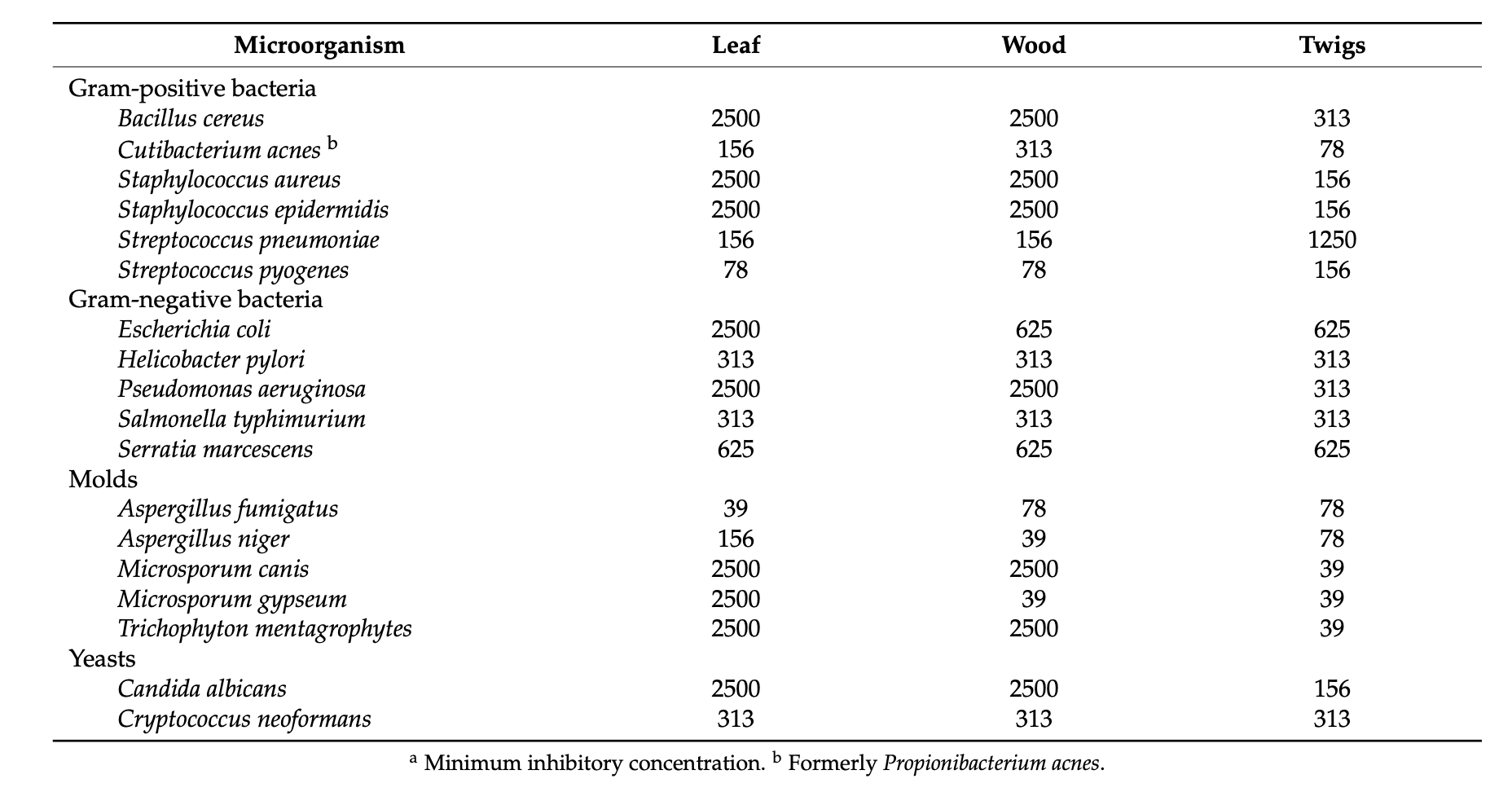
Antimicrobial activities, MICa (μg/mL), of essential oils of Myoporum sandwicense.